Air Commodore Cyril Norman Ellen: A Life of Service, Skill and
Leadership
« C N Ellen Index Page
NOTICE: WANTED - Flying log books and militaria for Air Commodore C N Ellen - if anyone reading this knows the whereabouts of the flying log books, or any other items, for Cyril Norman Ellen, we'd be enormously grateful if you would get in touch.
-------
Click here for
a detailed timeline of Cyril Ellen's career.
-------
Early Life and Cinema Roots
Cyril Norman Ellen was born on 6th
September 1895 at 15 Church Street, Seaham Harbour in the County of
Durham. Between 1905 and 1910, he attended Belmont Road Schools in South Tottenham, North
London, and was employed as a clerk between 1910
and 1913. At the age of nineteen, on 23rd April 1915, he joined the
Royal Naval Air Service (RNAS) as a volunteer and initially served as a
Probationary Chief Petty Officer, borne on the books of the accounting
base, HMS President II. His initial training
might have included a time at Crystal Palace, where ratings and officers
entering service in the RNAS underwent their basic training.
In addition, around this
period Cyril almost certainly undertook a stint at RNAS Kingsnorth.
Shortly before enlisting, he had applied to Major Fletcher at Hoo,
Kent, (ie. RNAS Kingsnorth) for a post as a 'Cinematograph Photographer'
and, given his professional
background, he was specifically assigned to the photographic branch.
From June 1913, he'd been employed by the Eclair Film Company and, during this time, he'd established himself as an "excellent camera
operator", securing first class negatives in various subjects, including
water and aviation pictures. He was familiar with Gillon large and small
cameras and a
Pathé machine and, at one stage, he was in complete charge of a
silent newsreel called the Eclair Cinema Journal.
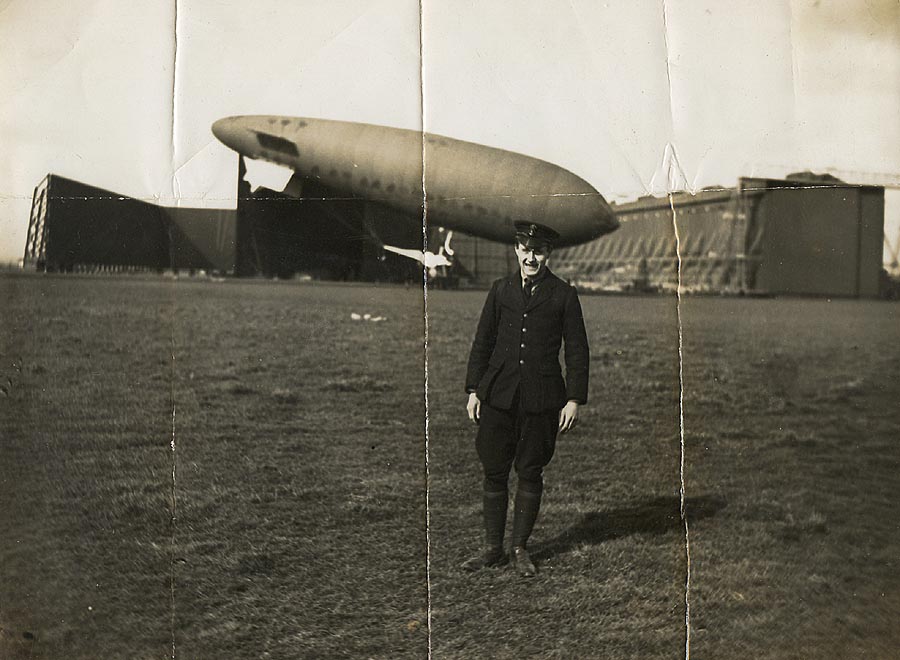
Cyril Ellen pictured outside the Hill and Smith steel shed at RNAS
Kingsnorth. Behind him sits an early SS-class airship prototype,
featuring a B.E.2c fuselage as its car. This experimental craft utilised
the repurposed envelope of airship HMA No. 2 (Willows No. 4) and was
designed and constructed specifically at Kingsnorth Airship station.
From Photographer to Combat Hero
On 1st July 1915,
Cyril joined the seaplane tender, HMS Riviera, operating with the Dover
Patrol. A pivotal engagement occurred on 18th June 1916. While flying in a Short
Admiralty 184 seaplane (No. 8357), piloted by Flight Lieutenant G.W.
Price, the engine caught fire, forcing a landing in a German minefield
eight miles north of Ostend. While stranded for several hours, the two
men successfully drove off attacks from three enemy aircraft using Lewis
gun fire. They were eventually rescued and towed to safety. This action,
demonstrating both technical composure and combat bravery, led to
Cyril's recommendation for a commission.
Read more about this incident here.
Despite an initial failure of his eye test due to
strain, in November 1916, Cyril was commissioned as a Sub-Lieutenant and
began training as an Observer at the RNAS schools in Crystal Palace and
Eastchurch. He qualified as a Wireless Telegraphy (W/T) Observer,
passing first on his course.
Aerial Reconnaissance and the Birth of the RAF
By 1917, Cyril was deployed to the Eastern Mediterranean with the Aegean
Squadron,
specifically No.2 Wing RNAS, "D" Flight (which later became 221 Squadron). Operating from
Stavros, the
reconnaissance work in the Neohori Sector was highly detailed, involving
the identification and tracking of numerous enemy battery positions. For
his "gallant conduct" in the Salonika theatre, he was
Mentioned in
Despatches and awarded the
Distinguished Flying Cross (D.F.C.) for
"valuable service in photographic flights at low altitudes and at times under
difficult conditions".
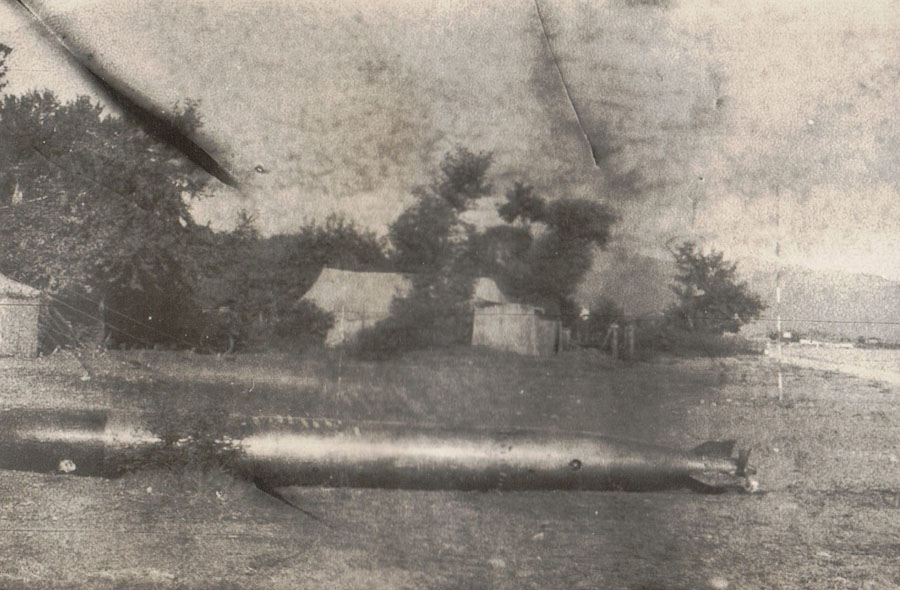
On 30th August 1918, the German submarine
UC 37 launched
a targeted torpedo attack against British naval forces stationed off
Stavros. While one torpedo successfully struck and damaged the Edgar-class cruiser
HMS Endymion,
a second, intended for the monitor
HMS Abercrombie,
failed to find its target. This photograph captures the second torpedo
after it narrowly missed its mark and ran aground on the beach at Stavros.
Cyril transitioned to the newly formed Royal Air Force in April 1918
and, following the war, he was posted to India with No. 31 Squadron,
where he attended the Mountain Warfare School in Abbottabad. He was
recorded as having "worked really hard" and took "great interest in the
schemes, demonstrations, etc.."
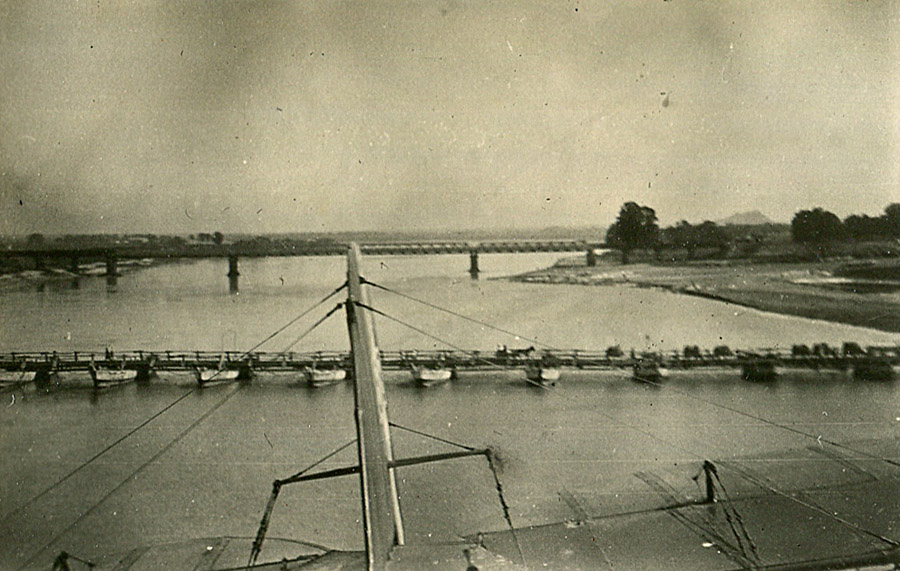
The Nowshera Boat and Railway Bridges spanning the
Kabul River, as seen from the air. Situated near
Risalpur, the primary Royal Air Force station and operational hub for
the North-West Frontier, these landmarks were central to the
landscape during
Cyril Ellen’s
posting with No.
31 Squadron.
Pioneering the Desert Air Routes
Though his applications to fly had been denied during the war, Cyril
underwent aviation training at the Almaza Air Base, (RAF Heliopolis)
Cairo, Egypt, and finally qualified as a pilot in 1921. He was posted to No. 45 Squadron
in Iraq where he served as a Flying Officer and Adjutant. He became a
pioneer of the Cairo-to-Baghdad airmail route, a gruelling 860-mile
journey across trackless desert. Flying the Vickers Vernon, Cyril faced
the harsh reality of early long-distance flight. In April 1922, he was stranded in the desert for several days near Azrak after
his port engine failed. Extensive repairs were conducted in
the heat until relief arrived. In another incident later that year, he
was forced to land 20 miles from Baghdad due to fuel pump failure. He
notably commended the local Sheik Faid, who provided food and protection
for his crew overnight. By February 1923, Cyril was invalided back to
the UK.
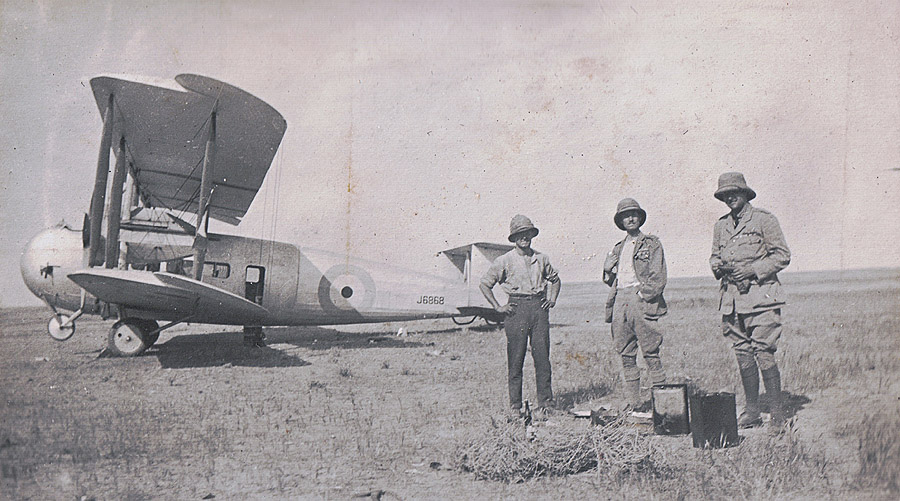
Cyril Ellen (centre) and two others standing
with Vickers Vernon (J6868) on a desert mud flat. This photograph might depict an incident on
15th April 1922,
during a flight from Cairo to Baghdad. After Cyril Ellen’s Vickers
Vernon (J6871) malfunctioned over the desert, he and four accompanying
aircraft were forced to land on the
Azrak mud flats.
The aircraft pictured here (J6868) was flown by
Flight Lieutenant
Saundby (later Air Marshal Sir Robert Saundby) who continued on to
deliver his mail whilst Cyril finally reached Baghdad on 29th April.
Signals Specialisation and Academic Contributions
Cyril spent much of the 1920s specialising as a Signals Officer,
completing the Long Wireless Telegraphy & Signals Course at Flowerdown
in 1924. During May and June 1925, he investigated the tragic death of
Flight Sergeant Frank Lowry, OBE, who was electrocuted during an aerial
wireless test. Upon re-examining the aircraft, he identified four
specific faults within the wireless apparatus and subsequently gave
evidence at the inquest. On 3rd October that year, he married Gladys Lily
Gardner.
Cyril held administrative and signals roles at RAF Leuchars
and RAF Cranwell and, whilst he was an instructor at the RAF Cadet College at Cranwell,
he wrote an entirely new book of lectures and revised the wireless
syllabus, an achievement that earned him an Air Ministry Commendation.
However, his dedication to this task meant he struggled to maintain his
required flying hours, necessitating a refresher course in 1930.
Command in India and the Quetta Earthquake
In 1932, Cyril returned to India with No. 20 (AC)
Squadron in Peshawar. During this time, under his command, the squadron
was involved in the "MOHCOL operations", receiving commendation for the
"great moral effect" of retaliatory air actions which influenced the
withdrawal of tribal fighters from the Nahakki area.
Cyril's service in India earned him a distinction of extreme rarity: the
India General Service Medal with the three-clasp combination of 'Mahsud
1919-20', 'Waziristan 1919-21', and 'Mohmand 1933'. While 100 medals
with three clasps were issued to the RAF, this specific combination of
clasps is recorded as unique within the service.
Cyril was promoted to Squadron Leader and in November 1933, he took
command of No. 5 (AC) Squadron in Quetta, British India. The following
year, he was the
Officer Commanding the Annual Flight through Mekran (present day Makran,
Balochistan) to
inspect and photograph various landing grounds and to demonstrate aerial
co-operation with a number of Mekran Levy Corps Posts.
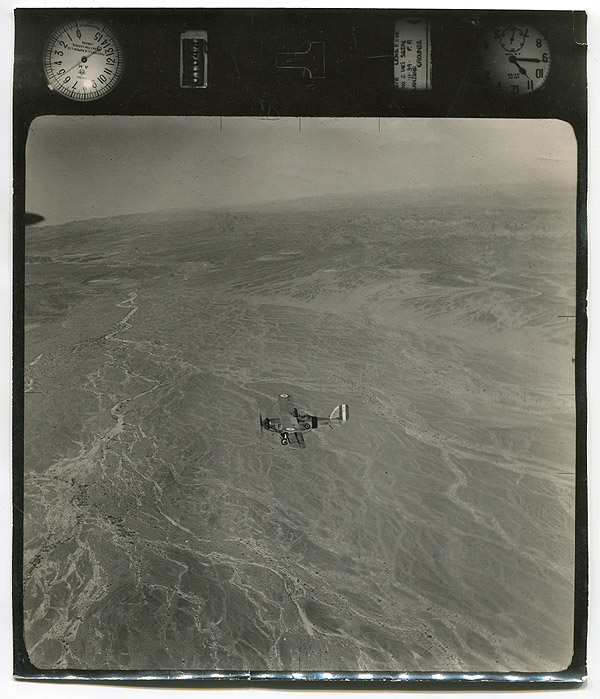
Westland Wapiti IIA K1309 during the Mekran Annual
Flight, November 1934. Piloted by Squadron Leader C.N. Ellen with
passenger The Honourable Mr. B J Gould, C.M.G., C.I.E., I.C.S (Note:
contemporary records identify Gould as the Agent to the
Governor General and Chief Commissioner in Baluchistan though he
officially held the post of Revenue and Judicial Commissioner during that
period).
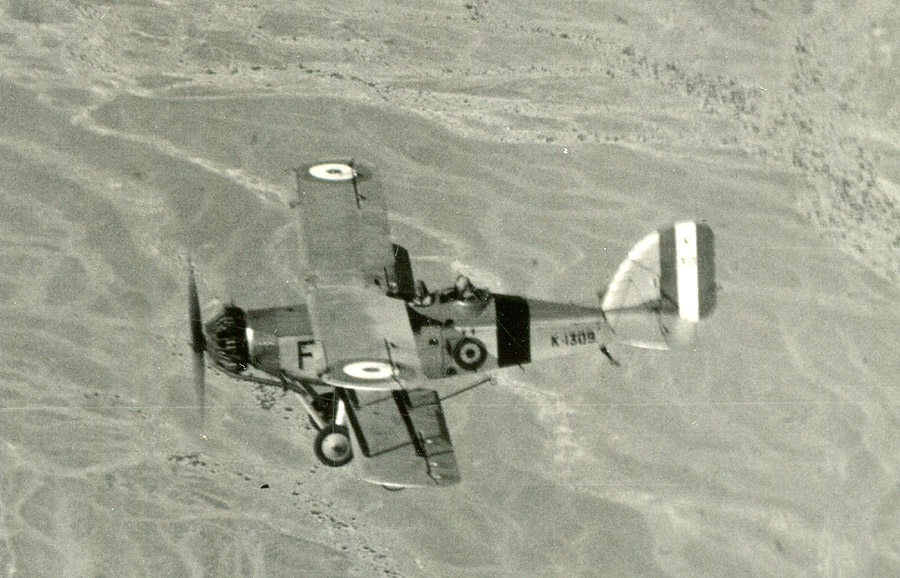
Close-up of the previous image: Squadron Leader
Cyril Ellen in the pilot's cockpit with B.J. Gould, C.M.G., C.I.E.,
I.C.S. seated in the observer’s (rear) cockpit.
Cyril's leadership
was tested during the catastrophic 1935 Quetta Earthquake. He and his
family survived and, while he oversaw his squadron's recovery, his wife,
Gladys, was awarded the Kaisar-i-Hind Silver Medal for her bravery
during the rescue work. Cyril was eventually flown to Karachi on 20th
June as a "sick" supernumerary and the family was evacuated to Tilbury
aboard the S.S. Narkunda.
Read the complete account of the
Ellen family’s experience of the Quetta Earthquake.
Technical Leadership in World War II
In 1937, Cyril was promoted to Wing Commander and transitioned to the
Technical Branch. After serving as the Chief Signals Officer, Technical
Training Command, he then became the Chief Signals Officer to the RAF
Component of the British Expeditionary Force when World War II broke
out.
With the war underway, Cyril assumed the rank of Group Captain and took
on pivotal leadership roles within technical training. From June 1940,
he was the Officer Commanding, No. 3 Electrical & Wireless School at
Compton Bassett, Wiltshire. He started and organised this school to hold
4000 trainees with a weekly turnover of 300.
In May 1942 he was appointed the Officer Commanding, No. 1 Signals
School (capacity 5000) at Cranwell, Lincolnshire. The school changed its
name to No 1 Radio School in 1943. It was at Cranwell in September
1942 that a large parade was held and Cyril subsequently received a letter
of congratulations, which was read out to the unit commanders.
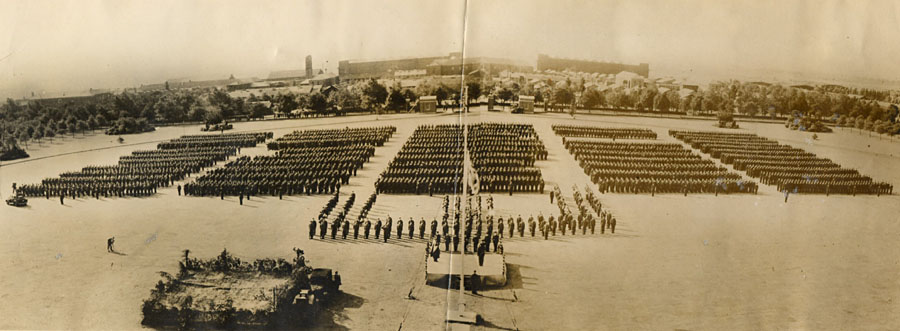
September 1942: Personnel on parade at No. 1
Signals School, Cranwell,
during Cyril Ellen’s tenure as Officer Commanding.
In February 1943 he became the Officer
Commanding, No. 7 Radio School (capacity 1500) which was located in the
South Kensington Science Museum, Exhibition Road, London.
Unlike his work building the school at
Compton Bassett from the ground up, Cyril’s appointments to No. 1
Signals and No. 7 Radio Schools required him to take over existing
operations to resolve sustained difficulties. Across all three commands,
he oversaw the education of tens of thousands of technical trainees.
In 1941, Cyril served as President of the Court of Inquiry on Consolidated Liberator Mk.I
(AM915). The aircraft was on a flight from Montreal to Ayr when it
struck Arinarach Hill near Campbeltown, claiming the lives of ten crew
and passengers. Cyril received a letter from Air Commodore Leslie
Hollinghurst (later Air Chief Marshal Hollinghurst) congratulating him on how he had
conducted the Inquiry, adding "it is a model of what a Court of Inquiry
of this nature should be".
At the end of 1943, he was appointed the Deputy Director of Technical
Training (Signals) at the Air Ministry and his contributions were
eventually recognised with a Certificate of Good Service from Technical
Training Command.
Post-War Disarmament and Diplomacy in Germany
In 1945, Cyril was deployed
with the Control Commission for Germany (CCG). As Director of Signals,
Air Division, he arrived in Detmold, Germany on 28th June 1945 and took
charge of the Signals aspects of disarmament under the overall direction
of Air Commodore Hart (later Air Marshal Sir Raymund
George Hart).
Cyril completed his Signals task in February 1946 and was transferred to
assist the Deputy Chief of Air Division in Berlin "on all matters". To
make way for the post-war contraction of the service, he was placed on
the retirement list with effect from 14th August 1946, retaining the
rank of Air Commodore.
Near the end of that same year, Cyril accepted an appointment with the Control
Commission under the Foreign Office as a Senior Control Officer. He
briefly commanded Kreis Group HQ Paderborn during the demobilisation of
the Commander until January 1947.
He then served as the British Resident in Landkreis Warburg, Westphalia,
until 1950. In this role, he acted as a representative of the British
government, a remand magistrate, and an honorary game warden. He was a
prominent figure in the local community, receiving formal holiday
greetings from German mayors and city directors who expressed hope for a
"better future" and "true peace". He was also a guest of honour at
significant regional events, such as the Warburg October Week, where he
appeared alongside future Federal President Heinrich Lübke.
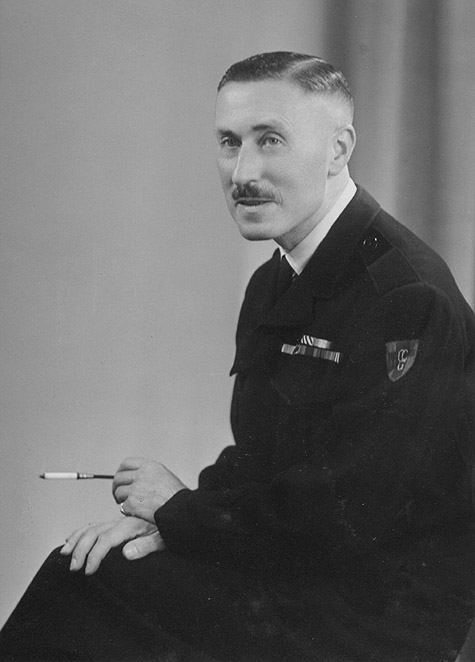
Cyril Ellen serving as the British Resident,
Landkreis Warburg, Westphalia
Cyril governed not through force, but through
"example and persuasion". Part of his résumé from this period acts as a
professional reference and reflects a man of absolute reliability,
having "political acumen" and "irreproachable character" as well as
noting he possessed a "logical and clear mind" and that his "loyalty and
integrity are beyond reproach."
Air Commodore Ellen died on 7th April 1981, in Plymouth, Devon.
-------
Sources
Service Record of C.N. Ellen.
Various Public Repositories and Archives.
The Ellen Collection of Personal Papers (Private Family Archive).
The Ellen Collection of Original Photographs (Private Family
Archive).
« Back
« C N Ellen Index Page
« C N Ellen & G L Gardner Page in Barnes Family Tree
|

